
- International SEO Services
International SEO Services for Global Market Expansion
- Hreflang done right
- Native-speaker localization
- Per-market strategy
- Global CDN performance
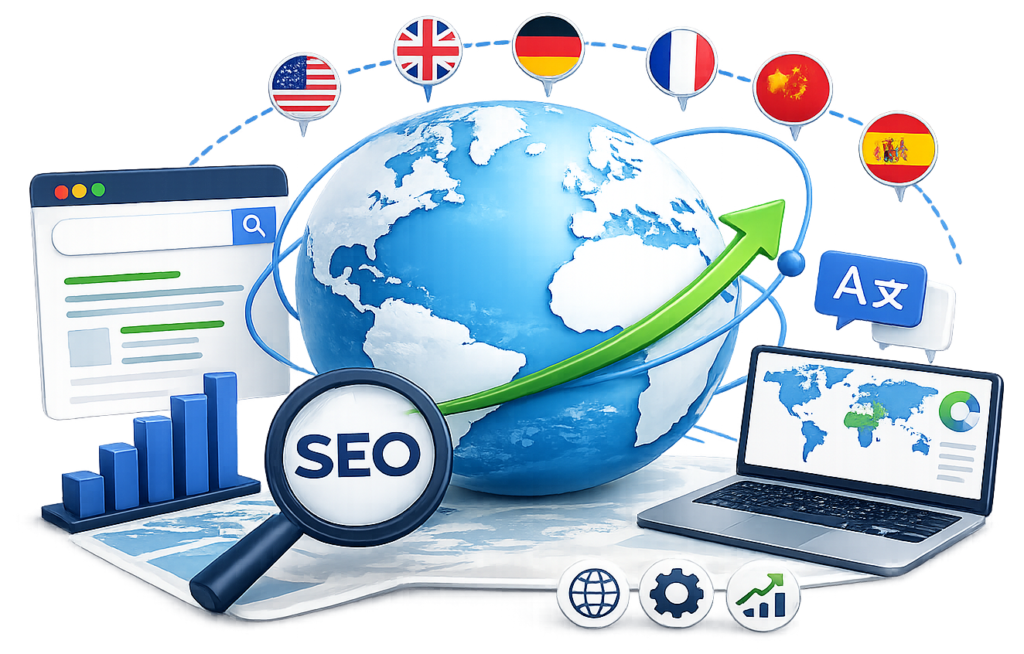
WHAT IS INTERNATIONAL SEO
More than one country. More than one language. Far more than one strategy
Multiple Languages
Translating content while maintaining SEO value
Regional Variations
Same language, different regions (English: US vs. UK)
Geo-Targeting
Telling Google which country each version is for
Technical Complexity
Proper URL structure, hreflang implementation, hosting decisions
Market Differences
Search behavior, keyword variations, cultural nuances vary by region
Our SEO STRATEGY
A five-step approach to going global.
Step 01
Market Analysis & Selection
Not all markets are worth targeting equally. We evaluate market size, search demand, competition,
profitability, and cultural fit — then prioritize which markets to enter, in what order, with what
resources.
- Market size & TAM
- Competitive difficulty
- Cultural fit for your offering
- Search demand & volume
- Revenue potential vs. localization cost
Step 02
Language & Localization Strategy
- Native-speaker translation
- Per-market keyword mapping
- Transcreation for messaging
- Regional variation handling
Step 03
URL Structure & Organization
The way you structure international URLs impacts SEO and UX. There’s no universal answer — the right pattern depends on budget, authority, and geo-targeting needs.
- Country-code TLDs (.co.uk, .de)
- Subdomains (uk.domain.com)
- Subfolders (domain.com/uk)
- Parameters — generally avoided
Step 03
URL Structure & Organization
The way you structure international URLs impacts SEO and UX. There’s no universal answer — the right pattern depends on budget, authority, and geo-targeting needs.
ccTLDs
.com.br, .co.uk, .de
Strong geo-signal, local trust. Multiple domains, higher cost.
Subdomains
uk.domain.com
Clean separation. Weaker link-equity sharing.
Subfolders
domain.com/uk/
Best link equity, centralized. Softer geo-signal.
Parameters
?region=uk
Generally not recommended for international SEO.
Step 04
Technical Implementation
- Hreflang across HTML / sitemap / headers
- Language-specific XML sitemaps
- Bidirectional & self-referential tags
- Per-market Search Console properties
Step 05
Localization Content Strategy
- Local keyword clustering
- Regional link-building
- Culturally adapted content
URL Architecture
Structure your international URLs the right way.
Option 01
Country-code TLDs
.com.br · .co.uk · .de
PROS
- Clear geo-targeting
- Local credibility
CRONS
- Multiple domains
- Higher cost
Option 02
Subdomains
uk.domain.com · de.domain.com
PROS
- Clean separation
- Individual ranking potential
CRONS
- Weaker link equity sharing
Option 03
Subfolders
domain.com/uk · domain.com/de
PROS
- Strong link equity
- Centralized management
CRONS
- Weaker geo-targeting signal
Option 04
Parameters
domain.com?region=uk
PROS
- Simple to add
CRONS
- Not recommended for international SEO
LANGUAGE OPTIMIZATION
Language-specific optimization, market by market.
🇬🇧
EN
English Markets
US · UK · CA · AU · IN, Different keywords (mobile vs. cell), spelling (color/colour), and regional search behavior. Separate domain structures usually recommended.
🇪🇸
ES
Spanish Markets
Spain vs. LATAM Spanish differ in keywords, pricing, and idiom. Often served from one domain with proper hreflang.
🇩🇪
DE
German Markets
Distinct variations per market, compound-word handling, and regional preferences in positioning and features.
🇫🇷
FR
French Markets
Quebec French differs meaningfully from European. Content must be culturally adapted, not just translated.
🇵🇹
EU
Other European
Smaller markets, often less competitive — high ROI when your service maps to local demand.
🌏
AS
Asian Markets
Very different market dynamics and search engines (Google is limited in China). Higher localization requirements throughout.
REGIONAL CHALLENGES
Regional Variations & Challenges
North America Expansion
US and Canada share a language but not a market. Canadian content needs proper geo-targeting; pricing, regulation, and audience preferences all diverge.
European Expansion
Multiple languages in tight geographic proximity, strict privacy regulation (GDPR), strong local competitors in every country.
Latin American Markets
Distinct regional Spanish variations, different purchasing power, and a growing market with less SEO saturation. Spain Spanish rarely works here.
Middle Eastern Markets
Arabic markets (KSA, UAE, Egypt) with very different search behavior, cultural considerations, and fast-growing e-commerce sophistication.
Asian Pacific Markets
Highly localized engines (especially China), very different user platforms, significant language variation, and less competitive digital markets.
Ai SEO for International
AI SEO for International Expansion
Automated Translation Quality Assessment
AI identifies translation quality issues
Keyword Research Automation
AI identifies keywords for each market faster than manual research
Content Adaptation
AI speeds localization while humans review for cultural appropriateness
Market Analysis
Machine learning models identify best expansion opportunities
Performance Prediction
AI predicts which markets will be most profitable
Competitor Analysis
Automated competitive intelligence for each market
Technical Checklist
The international SEO checklist we ship with every project.
Domain Structure
- Chosen appropriate domain structure for your markets
- Each version has appropriate hreflang tags
- Sitemaps submitted for each language/region
Search Console
- Separate properties for each market
- Target country set for each property
- International settings configured
Hreflang Implementation
- All language/region variants included
- Bidirectional links present
- Self-referential tags present
- No conflicting rel="canonical" tags
Language Declaration
- HTML lang attribute correct
- Correct XML:lang in sitemaps
Content Delivery
- Content served from appropriate servers
- CDN configured for global performance
- Page speed optimized for each region
Translation Quality
- Professional translation by native speakers
- Transcreation for marketing/branding content
- Grammar and localization review
Watch Out
Common International SEO Mistakes
- Automatic Translation: Using machine translation without human review
- Ignoring Regional Variations: Using Spain Spanish for Latin America, etc.
- Missing hreflang: Proper tagging is complex; many sites miss it entirely
- Duplicate Content: Multiple language versions of the same page confusing Google
- Single Domain: Using single domain for all languages without proper configuration
- Slow Performance Globally: Not optimizing for regional connection speeds
- No Local Presence: Expecting to rank without building local authority
- Generic Keywords: Not researching keyword differences by region
- One-Size-Fits-All Content: Using identical content across regions despite different preferences
- Ignoring Local Culture: Content that works in Pakistan might offend in other cultures
Measuring Success
Measuring International SEO Success
Metrics by Market
- Keyword rankings for each language/region
- Organic traffic by country
- Search Console impressions and clicks by country
- Conversion rates by market
- Revenue by market
Regional Performance Trends
- Which markets are growing fastest?
- Which markets have the highest ROI?
- Where should you invest more resources?
- Which markets are declining and why?
TIMELINE & COSTS
International SEO Timeline & Costs
Timeline
- Market analysis and strategy: 2-4 weeks
- Website setup and hreflang implementation: 2-4 weeks
- Initial content localization: 4-8 weeks
- First keyword rankings: 8-16 weeks
- Significant traffic and revenue: 6-12 months
Cost Factors
- Number of languages (translation cost scales)
- Volume of pages needing localization
- Complexity of market entry
- Degree of content customization needed
- Whether entering new markets or expanding existing presence
GET INTERNATIONAL EXPANSION CONSULTATION
Ready to expand your business globally?
FAQs
Frequently Asked Questions
Yes, hreflang is critical when you have content in multiple languages or targeting different regions. Without proper hreflang, Google may not understand your international structure.
Professional translation is essential for SEO. While tools are improving, they don't understand SEO implications and can miss subtle language nuances important to ranking and conversion.
This depends on your specific business. We analyze market size, competition, demand, and profitability to recommend optimal expansion sequence.
With proper hreflang tags and language declarations, Google understands multiple language versions. Without proper tags, Google may see them as duplicate content.
Separate view/property per market helps with analysis, but consolidated reporting showing comparative performance is also valuable for strategy.
Ultimately, revenue matters most. We focus on keywords with commercial intent in each market, prioritizing markets and keywords that drive profitability.